Throughout my two semesters in The Humanities Program we discussed the topic of justice through different academic lenses. My definition of justice brings together the perspectives offered from philosophy, law, anthropology, history, music, and dance.
During Dr. Jankovic’s lecture “Justice and Equality, Distributive Justice and Rawls’ Difference Principle” we considered Rawls’ definition of justice. Rawls believes that under the veil of ignorance and in the original position people would agree on two principles of justice: equality and difference. “Equality means that each person has the same indefeasible claim to the same equal liberties. If difference exists, it must be attached to offices and positions open to all, under conditions of fair equality of opportunity, or be to the greatest benefit to the least-advantaged members of society.” (Jankovic 2024) This is a theoretical version of the state of nature, and justice aims to return society to this natural state of equality.
To return society to the state of nature, there must be a restoration of what is lost. In Dr. Boyer’s lecture, “Justice, Humanity, and the Law”, he discusses God’s version of justice in The Bible. After God steals everything from Job and kills his family, he enacts justice by doubling everything Job lost. Replacing what was taken and giving more should make up for the loss, however the transaction is incomplete because Job will never get back the time he lost or forget the pain he experienced. The only way to address this lost time is to make the experience set a precedent and add meaning into the world. People often cope with a traumatic event by discovering something they gained from the experience or by helping future generations learn from their experience. Giving the injustice purpose, allows the pain to not be completely wasted. Ensuring that future generations remember, learn, and change because of the experience is essential to achieving justice.
One way that communities ensure that future generations remember injustices is through storytelling and oral tradition. Dr. Bowles illustrates how storytelling acts as a way to build community and preserve identity in her lecture about the role of storytelling in the formation of Shankleville community’s Black counterpublics. She explains how storytelling allows Shankleville, a freedom colony founded as an escape from slavery, to subvert assumptions of placelessness. By retelling the story of their town’s founding, community members are able to reassert their identity and counter outsiders beliefs about their community. The act of oral tradition is a way that past injustices are combated in the present.
Institutions also strive to document history and remember injustices. In Dr. Lipsker’s lecture From “Nuremberg to “Nuremberg””, he explains that the Nuremberg Trials punished many people who played a key role in the Holocaust, but it also prioritized memory and education. The Nuremberg Trials demonstrate how justice functions on a large scale. To achieve justice, the victims’ pain must be acknowledged and steps must be taken to stop the same crimes from happening again, whether through punishment or rehabilitation. Justice does not use punishment to avenge the victims. Instead, punishment serves as a way to discourage criminals from committing the same crimes; this is a necessary step if humanity is to return to a state of nature. However, in case of unfathomable injustices, like the Holocaust, the only adequate punishment is the death penalty. The verdicts of the Nuremberg Trials attempted to prevent similar events from happening, but also worked to preserve and document the suffering for history. The necessity to remember tragic events emphasizes that there must be something gained from suffering if justice is to be served. “Justification” means to find an explanation for an event, therefore justice must compensate for what is lost, if possible, and ensure the suffering was not pointless. Justice causes change, which allows for meaning to be made out of suffering.
Another way to remind society of past injustices is through memorials and monuments. In the lecture “Monuments and Memory,” Dr. Lipsker talks about the physical reminders of the holocaust that are present throughout Germany in the form of monuments. Some of the most successful memorials are the ones who honor individual people and their experiences, such as German artist Gunter Demnig’s Stolpersteine in the streets of Charlottenburg-Wilmersdorf. This memorial consists of small brass plates fastened into the street, which contain the name, birth date, and death date (if known), and what happened to the victims of the Holocaust who lived in each house. These small reminders force those who live in Charlottenburg-Wilmersdorf to reckon with the past and do everything possible to not repeat the injustices. Additionally, these personal memorials serve to hold victims’ place in history and ensure that their suffering is not lost or forgotten.
Each person has an obligation to fight for justice, so that we can return to the ideal state of nature. In Dr. Boyer’s lecture, “Justice and Obligation”, he uses Antigone to talk about conflicting obligations. Antigone prioritizes her obligation to justice over her obligation to the state. Antigone is willing to die for justice, demonstrating that justice is something we must fight for. Antigone’s acts of defiance are impactful because she risks everything; similarly acts of protest are only effective when people act in solidarity and put things on the line. Dr. Pyle’s lecture “The Power of Protest?” illustrated examples of successful protests, such as the Act Up protests which relied on the physicality of the human body. Protesters used their bodies to make change by staging die-ins and blocking buses from taking away the demonstrators. This demonstration, like many others, was impactful because it relied on people risking their safety and futures for change. Only when people take risks and act in solidarity, can they create change.
Though every person has an obligation to fight for justice, artists specifically are able to transform culture. Dr. Pyle’s quotes Nina Simone in his lecture “Sonic Activism: Billie Holiday and Nina Simone”: “An Artist’s duty is to reflect the times.” Those who have the capability and platform to reach the masses must spread awareness about injustice and fight for equality. Speaking up publicly about injustice is essential in achieving justice, because stories help to prevent the repetition of events.
Finally, justice aims to create a world where people can move freely, similar to cyphering. In Dr. Bory’s lecture “Understanding the Cypher”, she mentions the world-making aspect of cyphers: “when someone enters into a dance circle they are completely free”. Cyphers allow people to live in a space that did not previously exist. Justice is also world-creating, because of the precedent it sets through law and culture. Justice aims to create a better world where humanity exists in the state of nature. Justice is achieved by telling stories, rewriting history, publicly and privately remembering injustices, protesting, creating art, and making new meaning from pain. Justice is an ongoing process that will never be achieved so long as people are suffering, however, just because it seems impossible does not mean we should not strive to achieve it. A world with a desire to deliver justice is better than a world that gives up on the possibility.
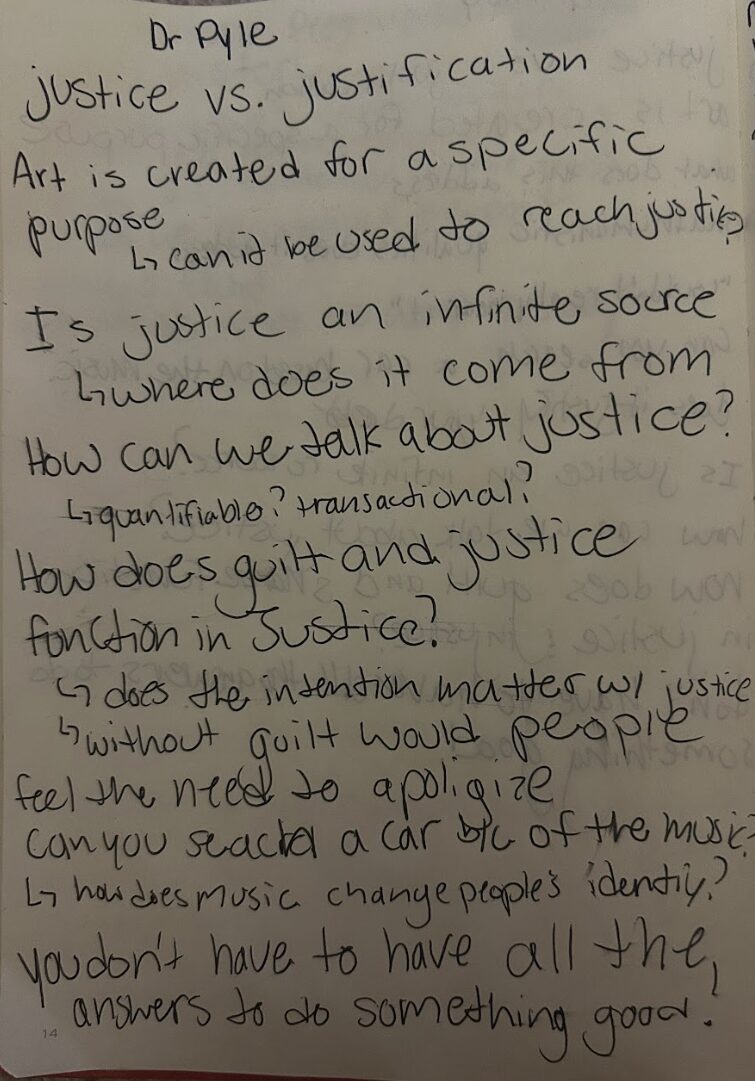
Notes from my journal about justice first semester.
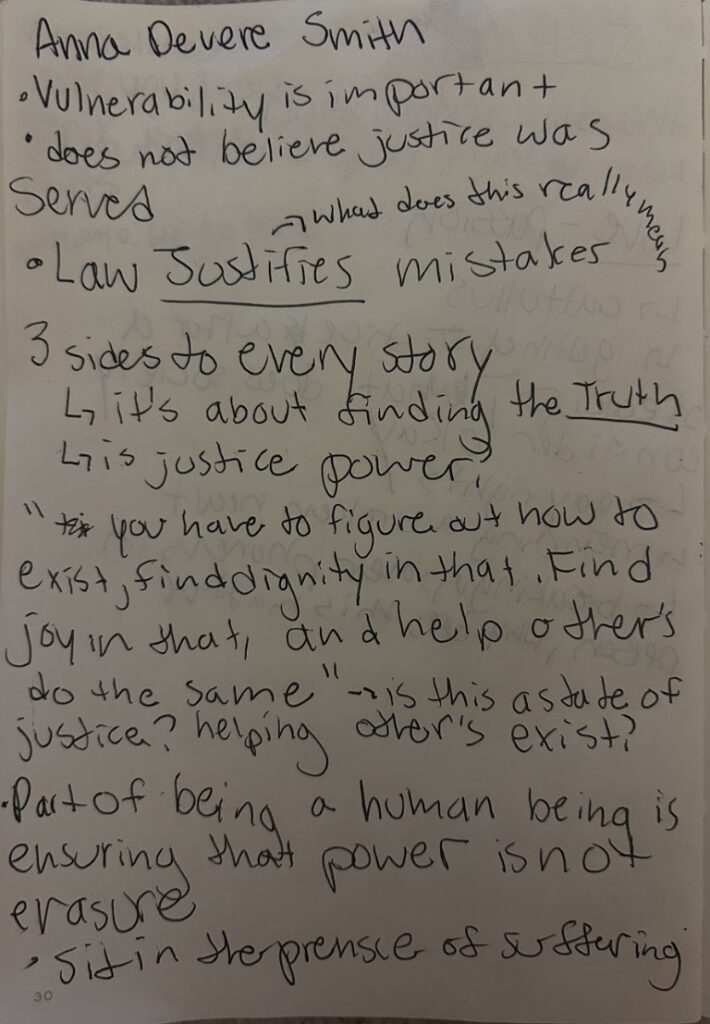
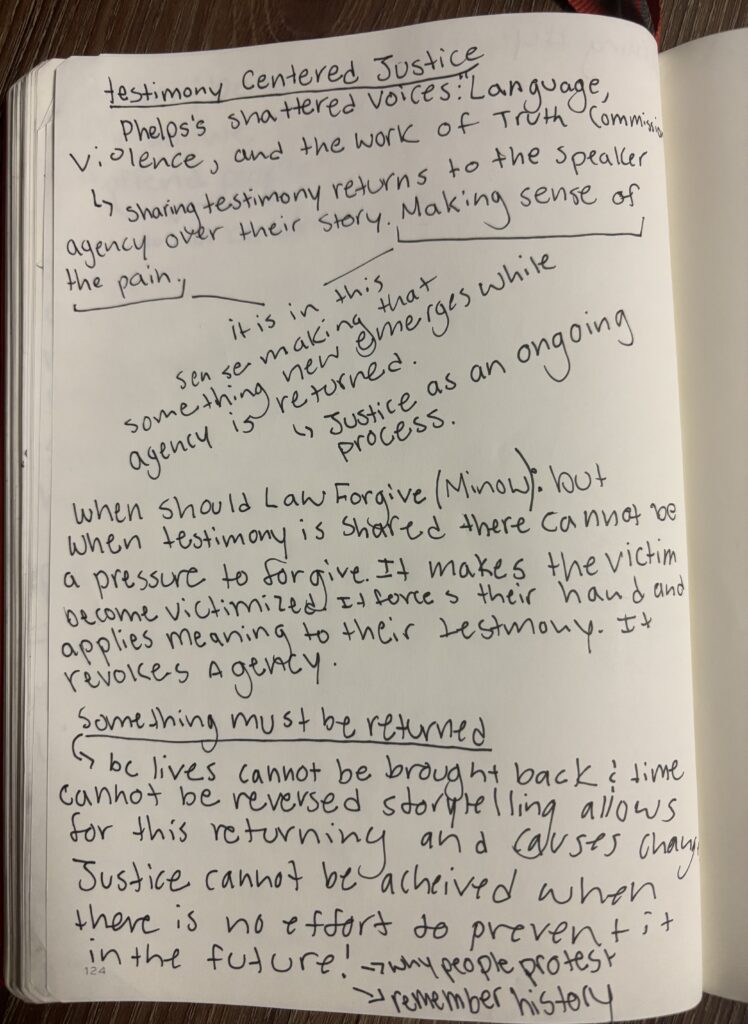
Notes from my journal about justice second semester.
Bibliography
Bory, Alison. “Understanding the Cypher” Humanities 103-0, 21 November 2024, Davidson College. Hance Auditorium. Lecture.
Bowles, Laurian. Humanities 104-0, 6 February 2025, Davidson College. Hance Auditorium. Lecture.
Boyer, Patricio. “Justice, Humanity, and the Law” Humanities 103-0, 24 September 2024, Davidson College. Hance Auditorium. Lecture.
Boyer, Patricio. “Justice and Obligation” Humanities 103-0, 17 September 2024, Davidson College. Hance Auditorium. Lecture.
Jankovic, Marija. “Justice and Equality, Distributive Justice and Rawls’ Difference Principle” Humanities 103-0, 10 September 2024, Davidson College. Hance Auditorium. Lecture.
Lipsker, Yaakov. “From Nuremberg to “Nuremberg”” Humanities 103-0, 17 October 2024, Davidson College. Hance Auditorium. Lecture.
Lipsker, Yaakov. “Monuments and Memory” Humanities 104-0, 20 March 2025, Davidson College. Hance Auditorium. Lecture.
Pyle, Marcus. “Sonic Activism: Billie Holiday and Nina Simone”” Humanities 103-0, 12 November 2024, Davidson College. Hance Auditorium. Lecture.
Pyle, Marcus. “The Power of Protest?” Humanities 104-0, 24 April 2025, Davidson College. Hance Auditorium. Lecture.